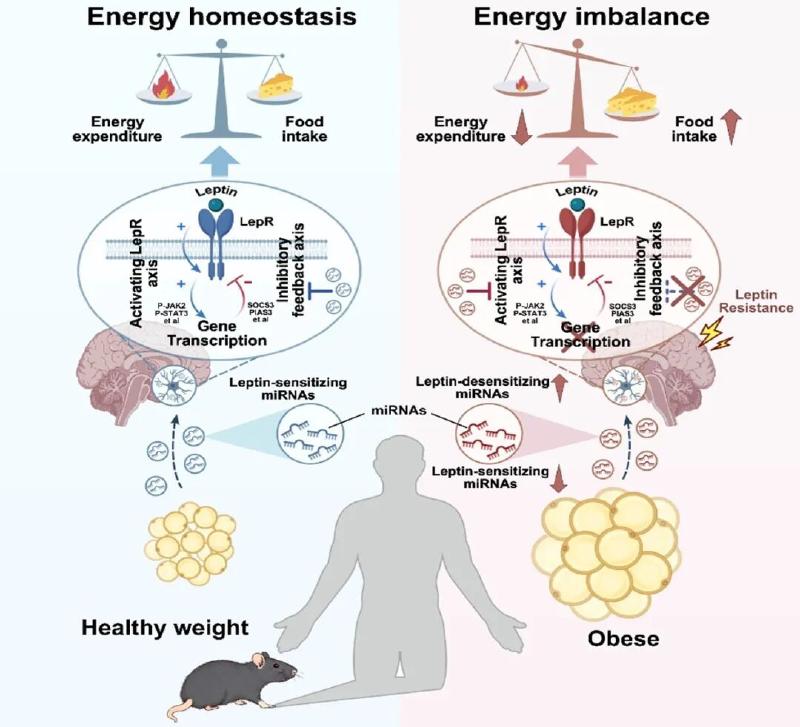
On 11 November 2025, the team of Yan Bi at Nanjing Drum Tower Hospital, Affiliated Hospital of Medical School, Nanjing University, published a research article in Cell Metabolism (IF=30.9) titled “Adipocyte-Derived Extracellular Vesicles Are Key Regulators of Central Leptin Sensitivity and Energy Homeostasis”, elucidating for the first time the initiating mechanism by which abnormal adipose–brain communication drives central leptin resistance. The study demonstrates that extracellular vesicles (EVs) derived from adipose tissue and the microRNAs (miRNAs) they carry are key molecules regulating central leptin sensitivity, opening an entirely new path to tackling central leptin resistance and developing novel obesity treatment strategies.

Obesity affects not only body shape but is also a central node in a complex disease network that clusters with metabolic diseases such as type 2 diabetes, hypertension, and hyperlipidemia, imposing a heavy burden on healthcare systems. Although lifestyle intervention, drug therapy, and metabolic surgery can achieve some degree of weight loss in the short term, overall efficacy is limited, with substantial individual variation and frequent rebound, failing to meet the needs of long-term, effective clinical management. The fundamental bottleneck is an insufficient understanding of the etiological mechanisms underlying the development of obesity.
The root cause of obesity is a chronic energy imbalance in which intake exceeds expenditure. Whole-body energy homeostasis is precisely regulated by a brain–body interaction network: the gut–brain axis mainly mediates short-term feedback on hunger and satiety, while the adipose–brain axis is the core feedback system maintaining long-term energy homeostasis; the two operate in concert to maintain metabolic balance. Notably, research on the gut–brain axis — particularly the translational application of drugs targeting the incretin pathway — has made remarkable progress, whereas the core mechanisms by which the adipose–brain axis regulates long-term homeostasis remain to be elucidated. Leptin, a key negative-feedback signaling molecule secreted by adipose tissue, acts on leptin-receptor (LepR)-expressing neurons in the central nervous system to suppress food intake and promote energy expenditure, thereby maintaining long-term energy balance. However, obesity is often accompanied by leptin resistance, which hinders the effective transmission of peripheral energy-storage signals to the brain and weakens the information coupling between adipose tissue and the brain. Although research on leptin resistance mechanisms has spanned nearly three decades, the traditional focus on events within the central nervous system has failed to reveal its initiating mechanism at the systems level.
The researchers first used adeno-associated virus (AAV)-mediated gene editing to construct an animal model with specific inhibition of adipose EV generation. The results showed that specific inhibition of adipose EV production led to significant weight gain and increased body fat in mice, attributable to increased food intake and reduced energy expenditure. To assess the weight-loss potential of adipose EVs, the researchers treated high-fat-diet-induced obese mice with adipose EVs from healthy or obese mice. Only adipose EVs from healthy mice significantly reduced body weight and improved the energy imbalance of high-fat-induced obese mice, whereas EVs from obese mice had no such effect. More importantly, adipose EVs derived from healthy humans likewise significantly reduced body weight and improved energy metabolism in obese mice. Together, these results indicate that adipose EVs play an important role in maintaining energy homeostasis.
Notably, healthy-derived adipose EVs could not reduce body weight in ob/ob (leptin-deficient) or db/db (leptin-receptor-deficient) obese mice, indicating that the weight-loss effect of adipose EVs depends on intact leptin signaling. Further studies found that blocking adipose EV generation did not alter leptin secretion or its entry into the brain, but significantly reduced the expression of downstream molecules in central leptin signaling, suggesting impaired central leptin signal transduction. Electrophysiological experiments confirmed that key energy-homeostasis-regulating neurons (AgRP and POMC neurons) showed markedly reduced responsiveness to leptin. In vivo tracing revealed that adipose EVs efficiently crossed the blood–brain barrier into the brain and specifically accumulated in LepR-expressing neurons of the hypothalamic arcuate nucleus. Moreover, central replenishment of adipose EVs significantly reversed central leptin resistance and energy imbalance caused by EV deficiency. All this evidence consistently confirms that adipose EVs maintain whole-body energy homeostasis by enhancing central leptin sensitivity.
What, then, is the key molecular mechanism by which adipose EVs regulate central leptin sensitivity? Previous studies indicate that adipose EVs contain multiple active components, among which miRNAs are key molecules mediating their biological effects. After the researchers specifically inhibited miRNA activity in adipose EVs using virus-mediated gene editing, the effects of adipose EVs on enhancing central leptin sensitivity and reducing body weight disappeared, confirming miRNAs as key components mediating these effects. Through small-RNA sequencing and AI-assisted target analysis, the team systematically classified the functional characteristics of miRNAs in adipose EVs for the first time, revealing that they form a complex regulatory network for central leptin signaling, divisible into two functional groups: one leptin-sensitizing group enhances signaling by suppressing negative-feedback factors of LepR signaling; the other leptin-desensitizing group weakens signaling by suppressing downstream effector molecules of LepR signaling. In the healthy state, adipose EVs are enriched in leptin-sensitizing miRNAs, and their loss is a key driver of central leptin resistance and obesity.
Finally, the team systematically elucidated the mechanism by which adipose EVs target the central nervous system, identifying the surface membrane proteins SIRPα and MCAM as key molecules mediating targeting to central neurons. On this basis, the researchers constructed engineered brain-targeted exosomes that efficiently target the central nervous system. Delivering leptin-sensitizing miRNAs to the brain with these brain-targeted exosomes significantly restored central leptin sensitivity in high-fat-diet-induced obese mice and effectively promoted weight loss and metabolic remodeling.