
LIGHT-MCI
Table of Contents
About the Project #
LIGHT-MCI (Liraglutide and Empagliflozin versus Linagliptin for reversion from mild cognitive impairment to normal cognition in type 2 diabetes) is an investigator-initiated, multicentre, open label, randomised controlled trial (ClinicalTrials.gov NCT05313529), conducted across 5 hospitals in China with recruitment between October 2022 and December 2024.
Type 2 diabetes accelerates cognitive decline by 5–10 years and is associated with approximately 16% of global dementia cases, yet adequately powered randomised evidence with cognition as a primary endpoint has been lacking. LIGHT-MCI was designed to fill this gap and test whether early cognitive impairment in type 2 diabetes can be reversed through the choice of glucose-lowering agents.
Study Design #
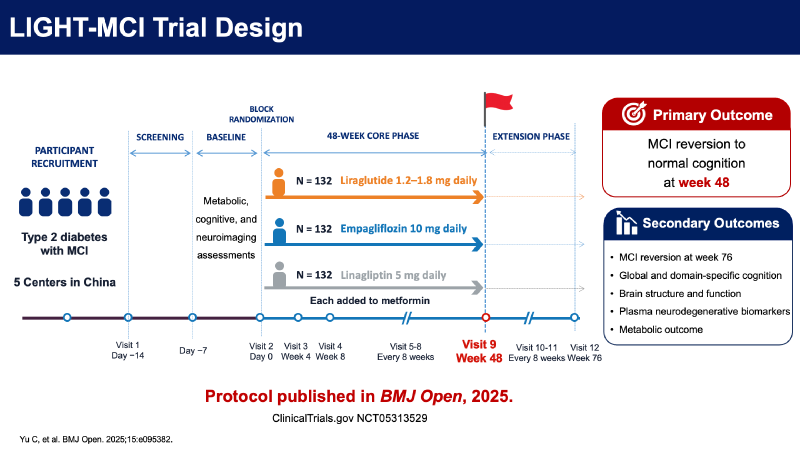
- Participants: 396 adults aged 40–75 years with type 2 diabetes and mild cognitive impairment (MCI; 37.6% women, mean age 60.5 years)
- Randomisation (1:1:1): liraglutide (titrated to 1.8 mg once daily), empagliflozin (10 mg once daily), or linagliptin (5 mg once daily, active comparator), each added to metformin
- Duration: 48 weeks of treatment, with an extension phase continuing assigned treatment to week 76
- Primary outcome: MCI reversion to normal cognition at week 48, defined as an education-adjusted Montreal Cognitive Assessment (MoCA) score ≥26, normal performance across all assessed cognitive domains, and preserved instrumental activities of daily living
- Secondary outcomes: reversion to normal cognition at week 76, changes in global and multidomain cognitive measures, structural and functional brain MRI measures, and plasma neurodegenerative biomarkers
Key Results #
At week 48, MCI reversion occurred in 49.6% (60/121) of the liraglutide group, 28.6% (36/126) of the empagliflozin group, and 20.6% (26/126) of the linagliptin group. In the intention-to-treat analysis, the risk ratio for MCI reversion versus linagliptin was 2.43 (95% CI 1.93–3.06, P<0.001) with liraglutide and 1.41 (95% CI 1.19–1.66, P<0.001) with empagliflozin; findings were consistent in per-protocol and sensitivity analyses. At week 76, reversion rates were 48.2%, 27.4%, and 19.3%, respectively, with the cognitive benefit of liraglutide sustained. Mild-to-moderate gastrointestinal events were more common with liraglutide. Of 396 randomised participants, 373 (94.2%) completed the primary outcome assessment.
Research Data #
De-identified analysis datasets and statistical code from LIGHT-MCI will be shared in accordance with FAIR principles and made available to qualified researchers upon request. Data access applications and sharing policies will be published via the following link; the data-sharing password will be dispensed upon reasonable request to the corresponding author.
Visit the Research Data Sharing Platform ↗Significance #
The LIGHT-MCI findings indicate that early cognitive impairment in type 2 diabetes is modifiable through treatment choice, providing high-level randomised evidence for an “early diagnosis – stratified management – precision treatment” pathway and supporting consideration of cognitive protection when selecting glucose-lowering agents for people with type 2 diabetes and MCI.
Study Team #
The trial was led by the Department of Endocrinology, Nanjing Drum Tower Hospital, Affiliated Hospital of Medical School, Nanjing University, in collaboration with the Clinical Epidemiology and Clinical Trial Unit of Children’s Hospital of Fudan University, the Department of Radiology, the Medical Statistics and Analysis Centre, and participating hospitals. Corresponding author: Professor Yan Bi.
There are no articles to list here yet.